Partial knee replacement
Designed for carefully selected knees where arthritis is limited to one suitable compartment. The unaffected bone, cartilage and ligaments are preserved.
Explore partial replacement ↗ PROF. DR. SAMMY HANNAMD · FACS · FRCS (TR&ORTH) · CCT (TR&ORTH)
KNEE SURGERY & REPLACEMENT · ABU DHABI
Surgery may enter the conversation when a clearly defined knee problem continues to cause pain or limit mobility and everyday function despite appropriate non-operative care. Depending on the diagnosis, treatment may range from keyhole surgery to partial or total knee replacement, robotic-assisted planning, or complex revision surgery. As one of the best knee replacement surgeons in Abu Dhabi, Prof. Hanna offers partial, total, robotic-assisted and revision knee replacement to patients across the UAE.
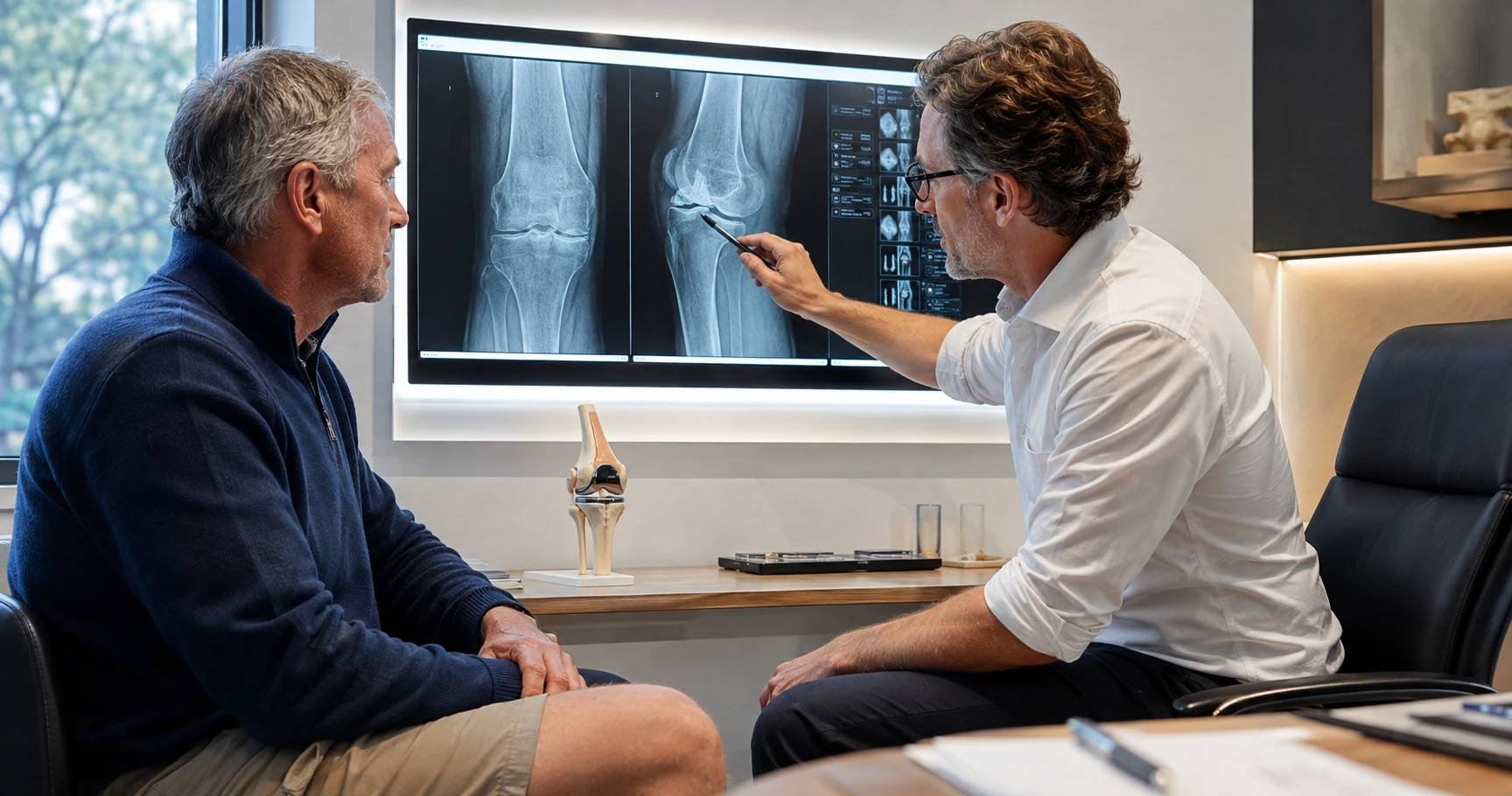
The diagnosis comes first. Imaging, examination, function, previous treatment and personal goals shape whether surgery—and which surgery—is proportionate.
THREE KNEE SURGERY GUIDES
The parent page helps you understand the route. Each guide then goes deeper into suitability, planning, the operation and recovery.
Keyhole surgery remains a separate pathway for selected intra-articular problems; it is not a knee replacement procedure.
Open arthroscopy guide ↗PRIMARY KNEE REPLACEMENT
Primary knee replacement includes partial and total procedures. The choice depends on the distribution of arthritis, ligament function, alignment, symptoms, examination findings and imaging.
Designed for carefully selected knees where arthritis is limited to one suitable compartment. The unaffected bone, cartilage and ligaments are preserved.
Explore partial replacement ↗Used when joint damage is more extensive and a broader replacement is appropriate. Metal femoral and tibial components articulate through a polyethylene spacer; the patella may or may not be resurfaced depending on the case.
Explore total replacement ↗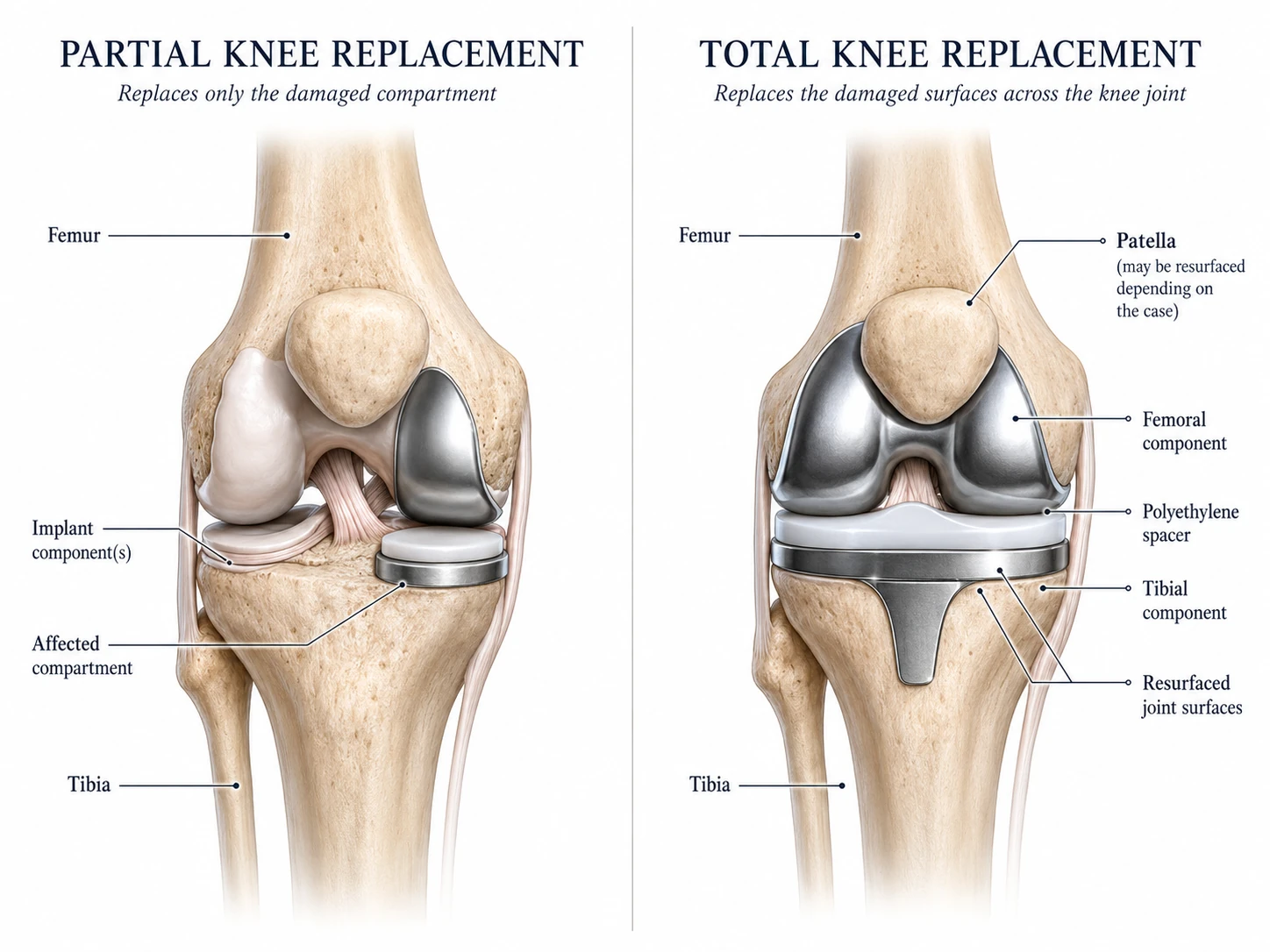
PRECISION · PLANNING · RECONSTRUCTION
Robotic assistance is a technology used within selected knee replacements, not a separate implant. Revision surgery is different: it begins with understanding why an existing replacement has become problematic and what reconstruction is required.
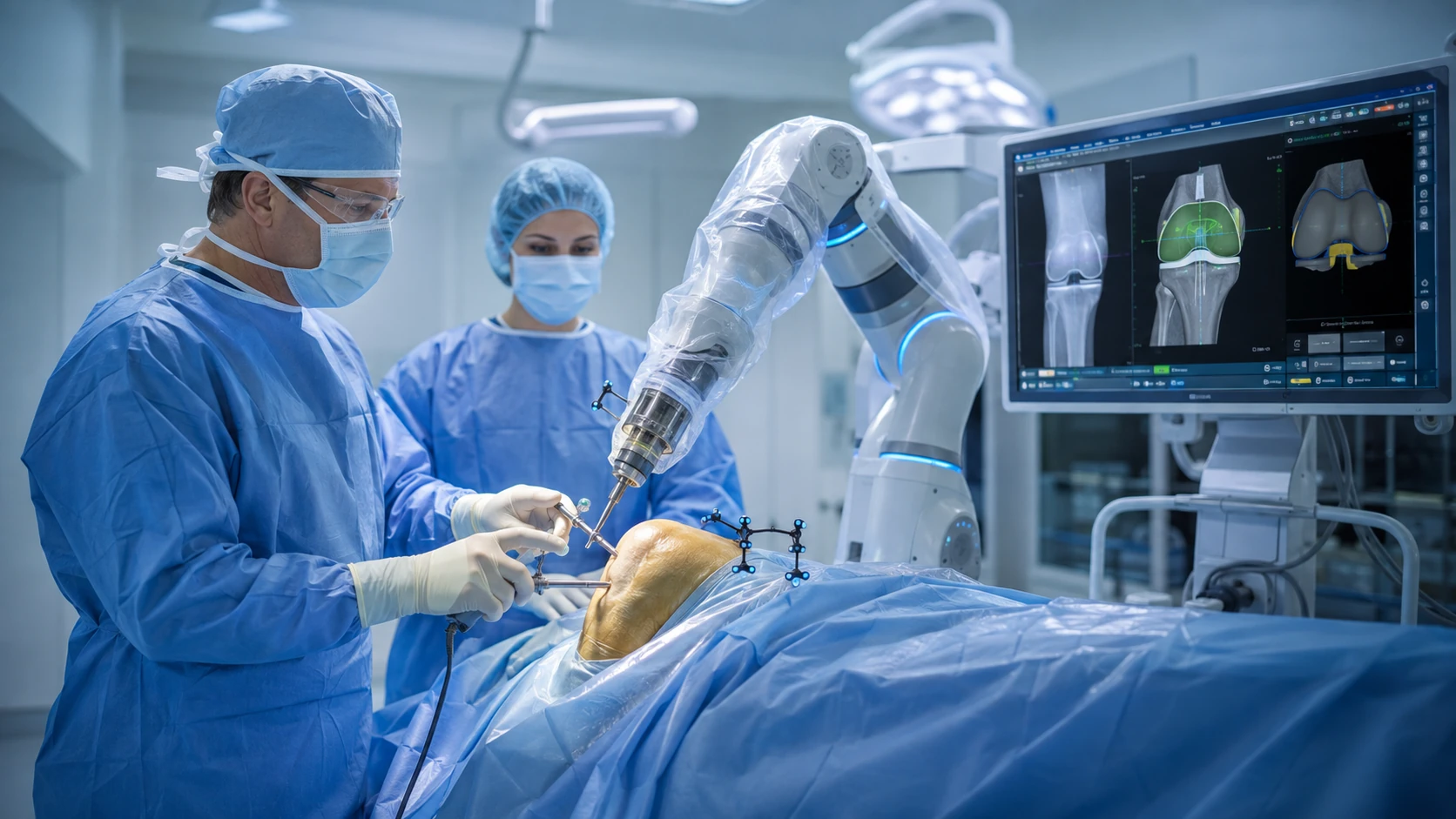
Depending on the robotic platform, imaging can be used to create a personalised three-dimensional plan before surgery. During the operation, robotic instruments and navigation can help the surgeon execute the planned bone preparation and component positioning.
Open the dedicated robotic guide ↗Revision planning may involve identifying why an existing replacement has developed a problem, assessing implant fixation and remaining bone, reviewing alignment and stability, and selecting an appropriate reconstruction strategy.
Explore revision knee replacement ↗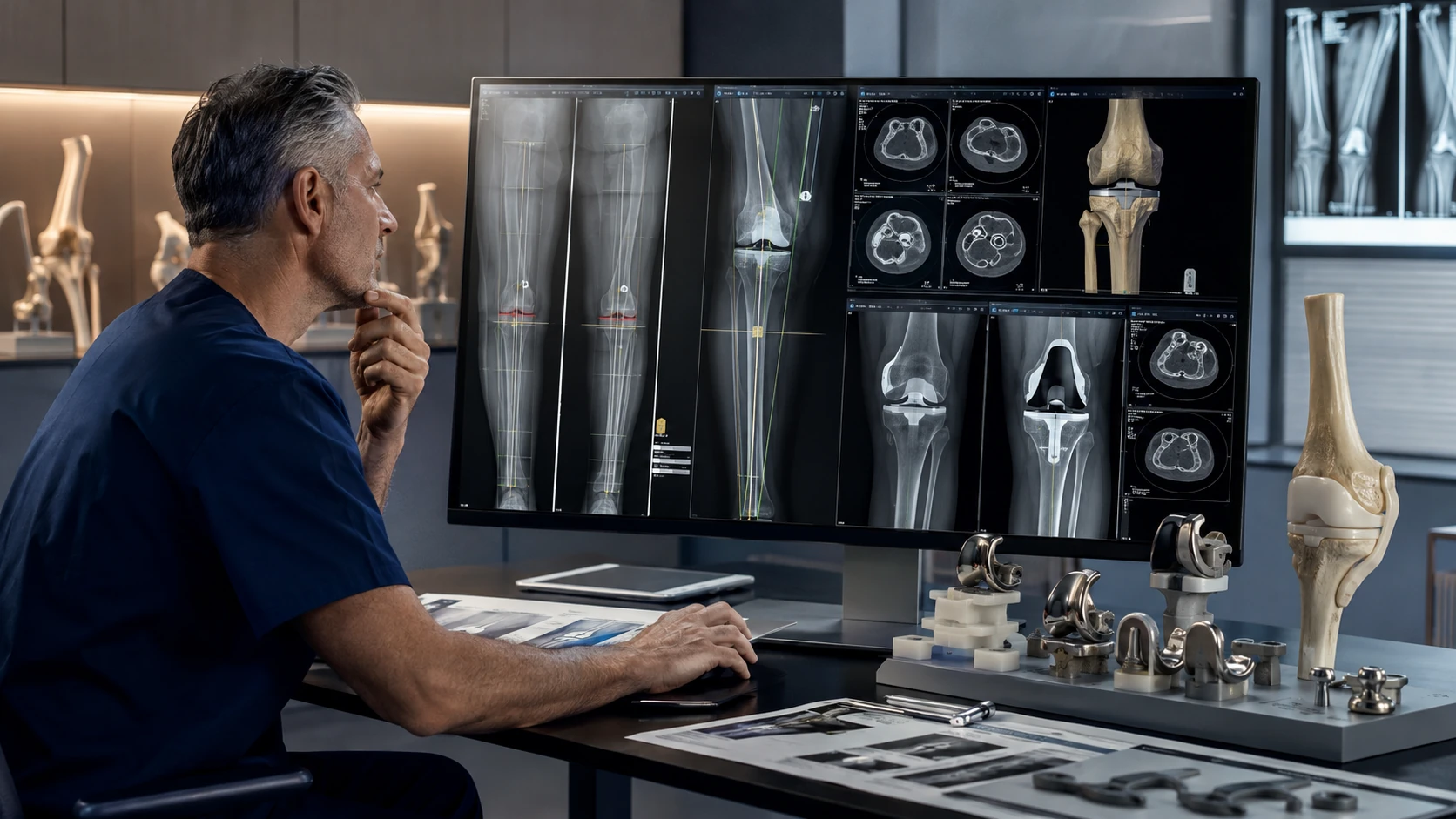
THE SURGICAL QUESTION SET
Imaging describes structure, but the surgical decision also needs to connect those findings with symptoms, function, examination, previous treatment, general health and the activities a person wants to regain.
Surgery is not automatic. An X-ray diagnosis of arthritis, or the presence of an existing implant, does not by itself determine the need for another operation.
Is the problem confined to one compartment, present across several compartments, or related to a previous replacement?
Walking distance, stairs, sleep, work, exercise and confidence help define the real-world impact of the knee problem.
Previous rehabilitation, medication, injections, activity modification and prior operations help show what has or has not been effective.
Weight-bearing imaging and examination help assess deformity, ligament balance, range of motion and the mechanical context of the joint.
Age alone does not define the plan. General health, expectations, lifestyle, activity goals and rehabilitation needs all influence the decision.
KNEE SURGERY & REPLACEMENT FAQs
General information only. The most appropriate procedure, together with its risks, benefits and expected recovery, requires an individual clinical assessment.
Request an appointmentReplacement may be considered when arthritis or joint damage causes persistent pain and loss of function despite appropriate non-operative treatment, and when the examination, imaging, health profile and personal goals support surgery.
Partial knee replacement treats a suitably localised compartment while preserving unaffected parts of the knee. Total knee replacement resurfaces damaged femoral and tibial joint surfaces across the knee when disease is more widespread.
Robotic assistance describes technology used to help plan and perform selected partial or total knee replacements; it is not itself a specific implant. The surgeon remains in control of the operation.
Revision may be considered when a previous replacement develops a significant problem such as loosening, wear, instability, infection, fracture around the implant or another cause of failure.
No. Patellar resurfacing may be performed in some cases, while in others the patella is retained without resurfacing. The choice depends on the clinical and surgical situation.
Recovery is progressive and individual. Walking, swelling, range of motion, strength and everyday function improve over time, while the pace varies with the procedure, health, rehabilitation and personal goals.

YOUR KNEE SURGERY SPECIALIST
Prof. Hanna is a UK board-certified consultant orthopaedic hip and knee surgeon at Healthpoint Hospital, Abu Dhabi, with specialist expertise in robotic-assisted joint replacement, primary knee replacement and complex revision surgery.
NEXT STEP
Bring previous imaging, your treatment history and the activities you want to regain. The consultation can clarify whether primary replacement, robotic assistance, revision surgery or another route is appropriate.