KNEE LIGAMENT INSTABILITY FAQ
Questions worth answering when the knee feels unstable.
General information only. The diagnosis and treatment of ligament injuries depend on the injury mechanism, examination, imaging when indicated, activity demands and whether one or several structures are involved.
Request an appointment →
01What does knee instability feel like?+
It may feel like giving way, shifting or loss of confidence during turning, uneven ground or sport. The exact sensation does not identify the injured ligament by itself.
02Which ligaments can cause instability?+
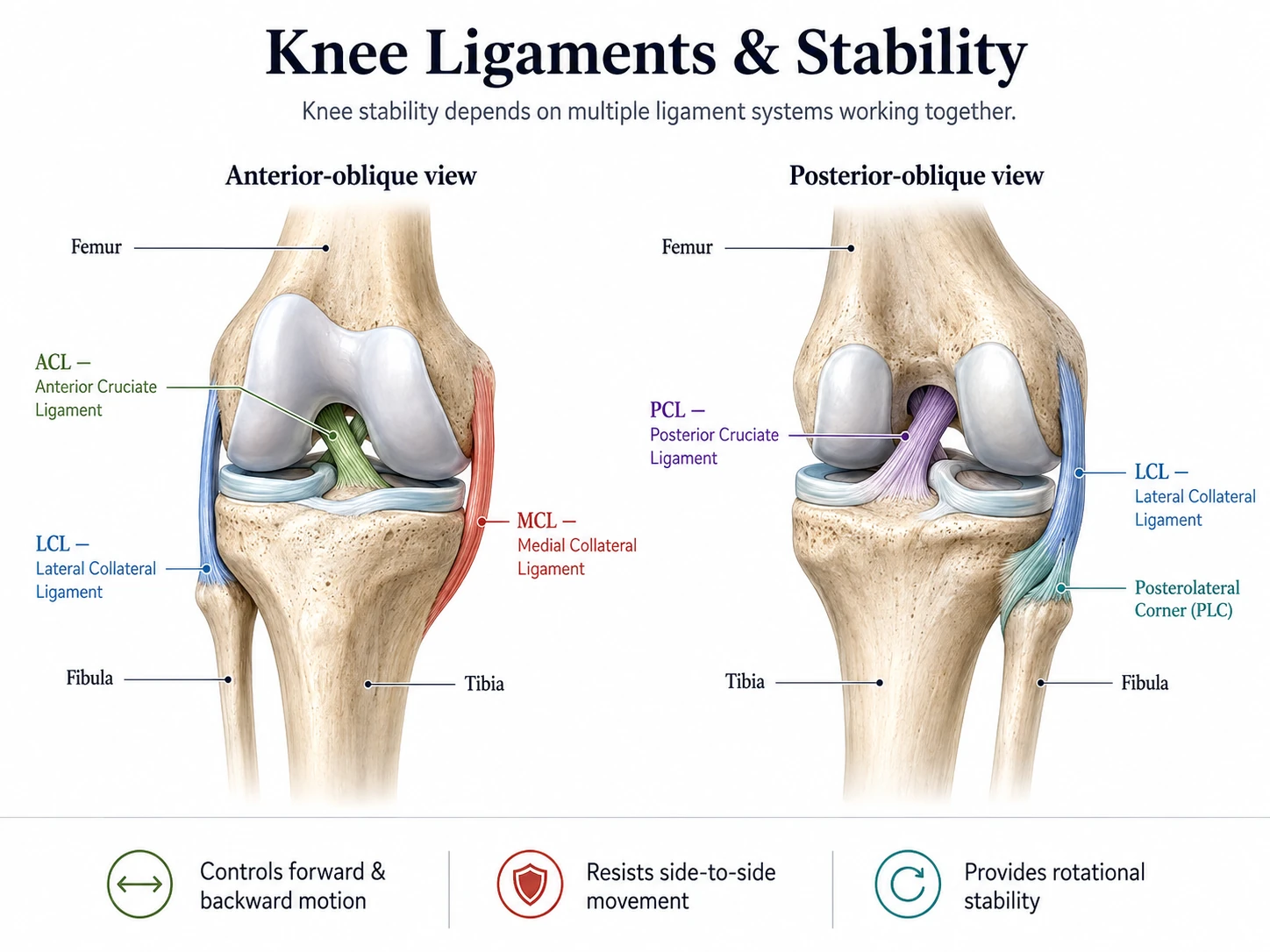
The ACL, PCL, MCL, LCL and posterolateral stabilising structures all contribute to stability. Some injuries affect one ligament and others involve several structures together.
03Does an MCL injury always need surgery?+
No. Many isolated MCL injuries are managed without surgery using protection and rehabilitation. Surgery may be considered for selected severe, chronic or combined injuries.
04How are PCL injuries assessed?+
The mechanism, posterior stability testing, range of motion and associated injuries are considered together. MRI or other imaging may be used when it will change management.
05Why are multi-ligament injuries different?+
They can create instability in several directions and may be associated with knee dislocation, meniscal or cartilage injury, or nerve and blood-vessel injury. The assessment is therefore broader and sometimes more urgent.
06Can rehabilitation restore stability?+
Rehabilitation can restore motion, strength, balance and neuromuscular control and is central to many ligament injuries. Whether it is enough depends on the injured structures, residual instability and activity demands.
07When is surgery considered?+
Surgery may be discussed for persistent or high-grade instability, some combined injuries, or when reliable stability is needed for higher-demand sport or work and non-operative management is unlikely to meet those goals.