Hip impingement is not one scan finding.The diagnosis depends on symptoms, movement and anatomy telling the same story.
Femoroacetabular impingement and labral problems can cause deep groin pain, pinching or mechanical symptoms, particularly with flexion and rotation. A labral abnormality on imaging does not automatically mean surgery is required. Hip impingement and labral tear treatment in Abu Dhabi is available at Healthpoint Hospital.
Choose the closest description. The result explains what may be useful to assess; it does not diagnose FAI or a labral tear.
PATTERN 01AN EDUCATIONAL GUIDE
Deep groin pain is provoked by flexion or rotation.
This can occur with FAI or other intra-articular hip problems. The examination checks which positions reproduce symptoms and whether the hip joint is the likely source.
Confirm whether the hip joint is the problem—and whether impingement is actually relevant.
The consultation connects symptom location, provocative movement, hip range, strength and the imaging question. A shape finding is common enough that it needs clinical context.
01
Does the pain pattern fit an intra-articular problem?
Deep groin pain is more suggestive than isolated lateral tenderness, but overlap is common.
02
Which movements reproduce symptoms?
Flexion and rotation may provoke impingement-type symptoms, but tests are interpreted with the whole examination.
03
How much motion is available?
Restricted rotation or flexion may reflect bone shape, joint irritation, arthritis or another cause.
04
How does the hip control load?
Strength, gait, trunk and pelvic control can influence symptoms and rehabilitation planning.
05
Could the pain be coming from elsewhere?
Back, tendon, abdominal, pelvic and other causes may need consideration when the story does not fit.
EXAMINATION / 02
“The scan should answer a clinical question—not create the diagnosis on its own.”
CHAPTER 03 · IMAGING
Imaging defines anatomy.It still has to match the symptoms.
Plain X-rays help assess joint shape and arthritis. MRI may be used when labral, cartilage or soft-tissue detail is likely to affect management, while CT can be selected for more detailed bony anatomy or surgical planning.
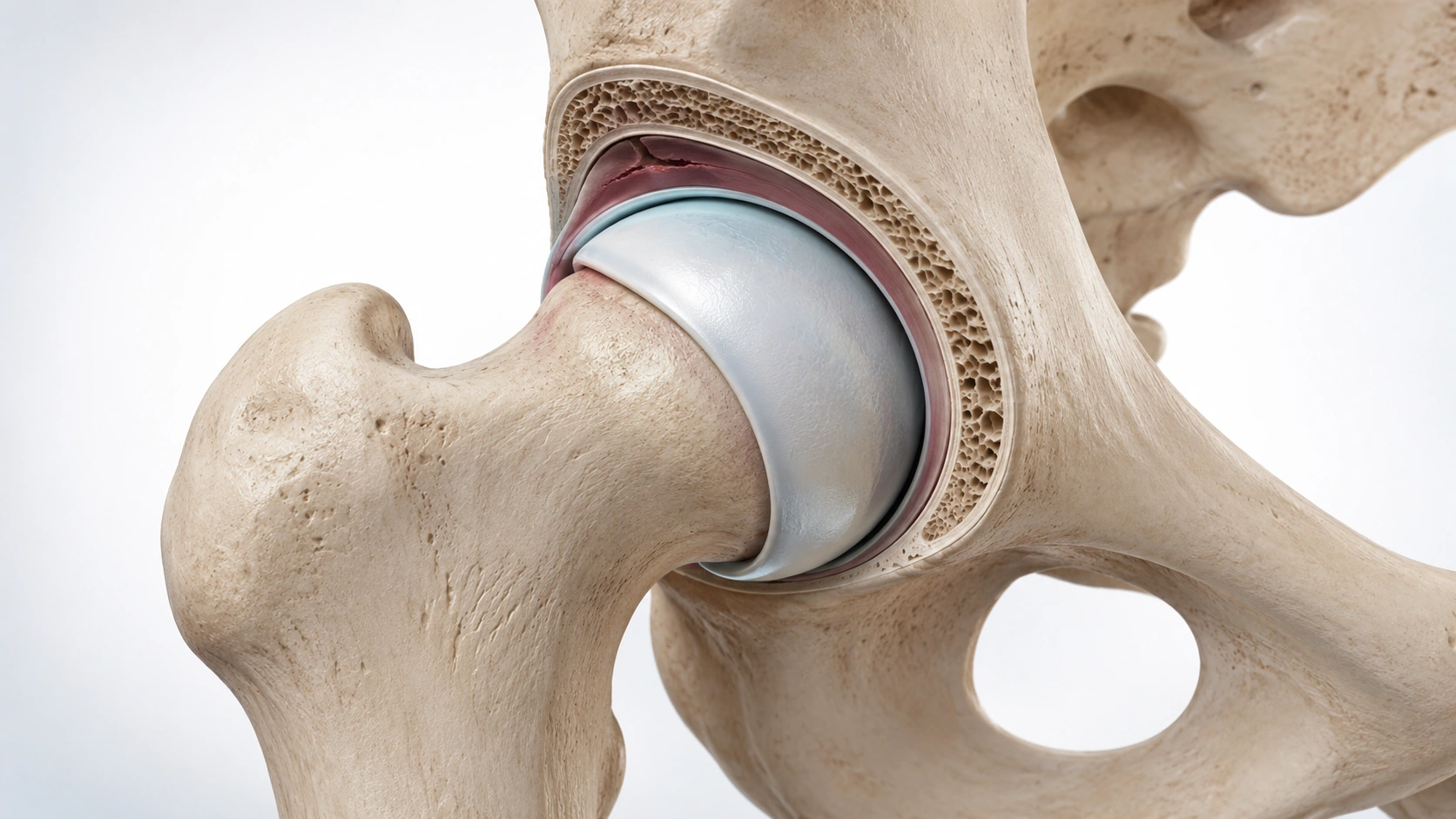
Educational labral illustration. FAI diagnosis also requires assessment of hip shape, symptoms and examination findings.
SELECTED QUESTION 01 / 03
X-ray · bone shape
Plain radiographs can help describe cam or pincer morphology and show whether arthritis is also present. Shape alone does not establish that the finding is causing symptoms.
CHAPTER 04 · OPTIONS
Treatment follows the clinical problem. Not the MRI report.
The plan depends on symptoms, function, joint condition, anatomy, sport or activity goals and previous care. Rehabilitation and surgical options are considered in proportion to the problem.
ROUTE 01
MODIFY LOAD
Change the positions and loads that repeatedly provoke the hip.
What it may include
Temporary activity modification, technique changes, pacing and a plan to preserve useful movement while reducing repeated provocative positions.
What it cannot promise
Activity modification does not change bone shape. The goal is symptom control and function while the diagnosis and longer-term plan are clarified.
↔Not every labral finding needs an operation. Surgery is considered when symptoms, examination, joint condition and imaging support a correctable problem and the trade-offs are proportionate.
CHAPTER 05 · DECISION
When does hip arthroscopy enter the conversation?
Not because a labral tear appears on MRI. Surgery may be considered when persistent symptoms and meaningful functional limitation fit the examination and imaging, non-operative care has not provided an acceptable result, and the joint is suitable for preservation.
01
The symptoms fit
The pain and mechanical pattern are consistent with an intra-articular hip problem.
02
The examination fits
Provocative movement and range of motion support the same clinical story.
03
The imaging fits
Bone shape, labrum, cartilage and joint condition support a correctable pathway.
04
The trade-offs are understood
Rehabilitation, expected limits, risks and alternatives are discussed before deciding.
IF THE JOINT IS MORE ARTHRITIC THAN PRESERVABLE
The route may be different.
Established arthritis and substantial loss of joint space can shift the discussion away from preservation and toward arthritis or replacement pathways.
For an active person, success may mean sitting comfortably, training, changing direction, lifting, running or simply moving without repeatedly protecting the hip. Those goals guide rehabilitation and any surgical discussion.
Comfortable sitting & flexion
Strength & movement control
Sport-specific load
Confident everyday function
RELATED HIP ROUTES
Groin pain may not be an impingement problem.
Use the related pages when arthritis, replacement or the broader Hip overview is the better starting point.
HIP IMPINGEMENT & LABRAL FAQ
Questions worth answering before treatment is chosen.
General information only. A diagnosis and personal recommendation require an individual clinical assessment.
FAI describes a shape-related conflict between the femoral head-neck region and the acetabular rim that can limit motion and irritate joint structures in some people.
02Does a labral tear on MRI always explain hip pain?+
No. Labral abnormalities can be present without being the main pain source. The finding is most useful when it fits the symptom pattern, examination and other imaging.
03Where is FAI pain usually felt?+
Pain is commonly felt in the groin and may be provoked by flexion, rotation, squatting or sport. Symptoms can overlap with other hip, back or soft-tissue problems.
04Do I always need an MRI?+
No. Plain X-rays are often useful to assess bone shape. MRI may be selected to assess the labrum, cartilage and other soft tissues when the result is likely to affect management.
05Can FAI be treated without surgery?+
Yes. Activity modification, rehabilitation and symptom management may be appropriate. Surgery is considered only when symptoms, examination and imaging support a correctable intra-articular problem and non-operative care has not provided an acceptable result.
06What does hip arthroscopy treat?+
Hip arthroscopy can be used in selected cases to address problems such as impingement-related bone shape and labral pathology. The exact procedure depends on the diagnosis and joint condition.
07When should hip pain be assessed urgently?+
Seek urgent assessment for severe pain after injury with inability to bear weight or deformity, a hot swollen joint with fever, or other rapidly worsening concerning symptoms.
MECHANISM · MOVEMENT · IMAGING
The scan matters only when it fits the hip.
Bring the symptom timeline, sport or activity triggers and any previous imaging. The consultation connects those pieces before deciding whether rehabilitation, further investigation or surgery is proportionate.
Prof. Hanna is a UK board-certified consultant orthopaedic hip and knee surgeon at Healthpoint Hospital, Abu Dhabi. His clinical interests include primary and revision hip and knee replacement, robotic-assisted joint replacement and arthroscopic treatment of selected sports and soft-tissue conditions.